When playing with unknown or inexperienced people it might be not be evident to play with complex strategies, so the strategies used during most public sessions usually come down to one of the two below. The second one is a simplification of the first one for beginners who aren’t used to the repositioning.
Basic Strategy
The general rule in this formation is that the person in the middle in the front is the setter and thus everyone will try to pass the receive to him if possible. The second ball is for the setter; if he can’t get it, he will shout “Help!”. The other two frontline players are the main attackers, though setting to the middle back is also possible of course (tip: first check if that player is ready to handle those).
During normal play – opponent has the ball.
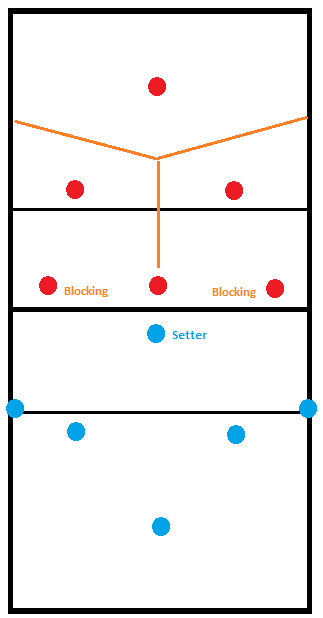
When the other team has the ball and is likely to spike the frontline of our team will set itself up to block it. In the first diagram the red team is in this situation. The setter can also block, though he’ll have to be ready to set the second ball when the time comes.
The backline is in a triangle and are responsible for the area delimited by the orange lines.
During normal play – we have the ball.
When we have the ball, we want to try to set up a set and spike. The attackers will move back and to the side so they can do their approach properly. In the first diagram the blue team is in this situation. The backline stays roughly the same, though the player behind the spiker should be ready to receive the rebound of a block or even the falling ball of a joust.
During the opponent’s serve
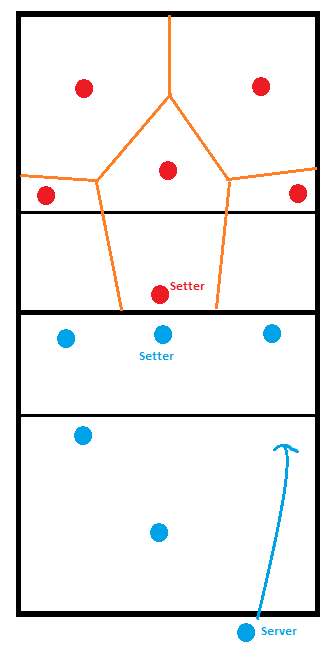
When we’re serving, we ready ourselves in the same formation as if the opponent has the ball, but if we’re receiving the opponent’s serve the formation changes a bit, especially the backline, as shown in the second diagram, where red is receiving.
The setter will want to get the second ball and thus avoids participating in the receive. The two other frontline players will help with the receive while staying close to the position they start their spike approach from. The middle backline player stays closer to the front than usual and is responsible for balls that are short or in the middle. The two backline players at the sides move back and receive the far balls that come to their corner or go far behind the middle backline player.
Simplified Basic Strategy
For the simplified version we stick to the positions explained in the above “During the opponent’s serve”. It has quite some weaknesses, but it’s simple to explain and follow and always the same. Once most of the players are comfortable with playing Volleyball it’s better to use the other strategy.